

CASE STUDY
Lothian Buses
× Optimo
116
Connectors
6MVA
Power Supply
3
Transformer Circuits
3 MW
Tradable Flexibility
48 h
Hours Full Transition
Live since April 2026,
100% pull-out maintained throughout
When a critical operator's charging platform of choice goes into administration overnight, Edinburgh's buses couldn't wait.
Optimo replaced the entire system in 48 hours.
Every bus pulled out on time.
What we proved
48 hours to transition. No interruption to scheduled fleet operations. A rapid deployment demonstrating how fleet operators can protect operational continuity without replacing their existing charging infrastructure.
Full site transition completed in 48 hours, bringing 116 connectors across mixed Kempower and Nidec hardware under Optimo management.
Dynamic load distribution across three transformer circuits, managing charging demand within the depot's electrical constraints.
Departure-based charging priorities configured to support daily fleet readiness and simplify charging operations for depot staff.
Continuous operational monitoring, automated fault detection and remote support to identify and resolve charging issues.
Up to 3 MW of potential flexibility identified for future energy market participation, subject to site and market eligibility.

The Challenge
Protecting Operations Before Disruption
When the future of its existing charging management platform became uncertain, Lothian Buses couldn't afford to wait for disruption.
An emergency tender. A 48-hour transition. Fleet operations protected.
When Lothian Buses identified the risk of its incumbent charging management provider entering administration, it acted decisively, initiating an emergency tender to safeguard its electric bus operations.
The challenge was to transition the depot's existing Kempower and Nidec charging infrastructure to a new platform, while maintaining charging schedules and managing power distribution across three transformer circuits. With thousands of passengers relying on its services daily, operational disruption was not an option.
Lothian selected Optimo to deliver the transition. Within 48 hours of receiving the green light, the depot was operating on Optimo's platform, with intelligent charging control, real-time visibility and operational support in place to keep its electric fleet moving.
The rollout
Live system in days. Value in weeks. Revenue in months.
Optimo deployed on-site with one objective: full operational control within 48 hours, with no loss of charging capacity and no disruption to overnight operations. A senior Optimo engineer was on-site from day one through day four, providing continuous oversight and real-time coordination with Lothian's engineering and operations teams. All issues resolved in real time. No delays. No escalation gaps.
Day 1 - Site alignment, platform pre-configured and calibrated, first chargers live
Day 2 - Full site transition complete, all 109 connectors under Optimo management
Day 3 - Lothian team training, onboarding and standard operating procedures established
Day 4 - Hypercare period begins, two weeks of intensive monitoring and support
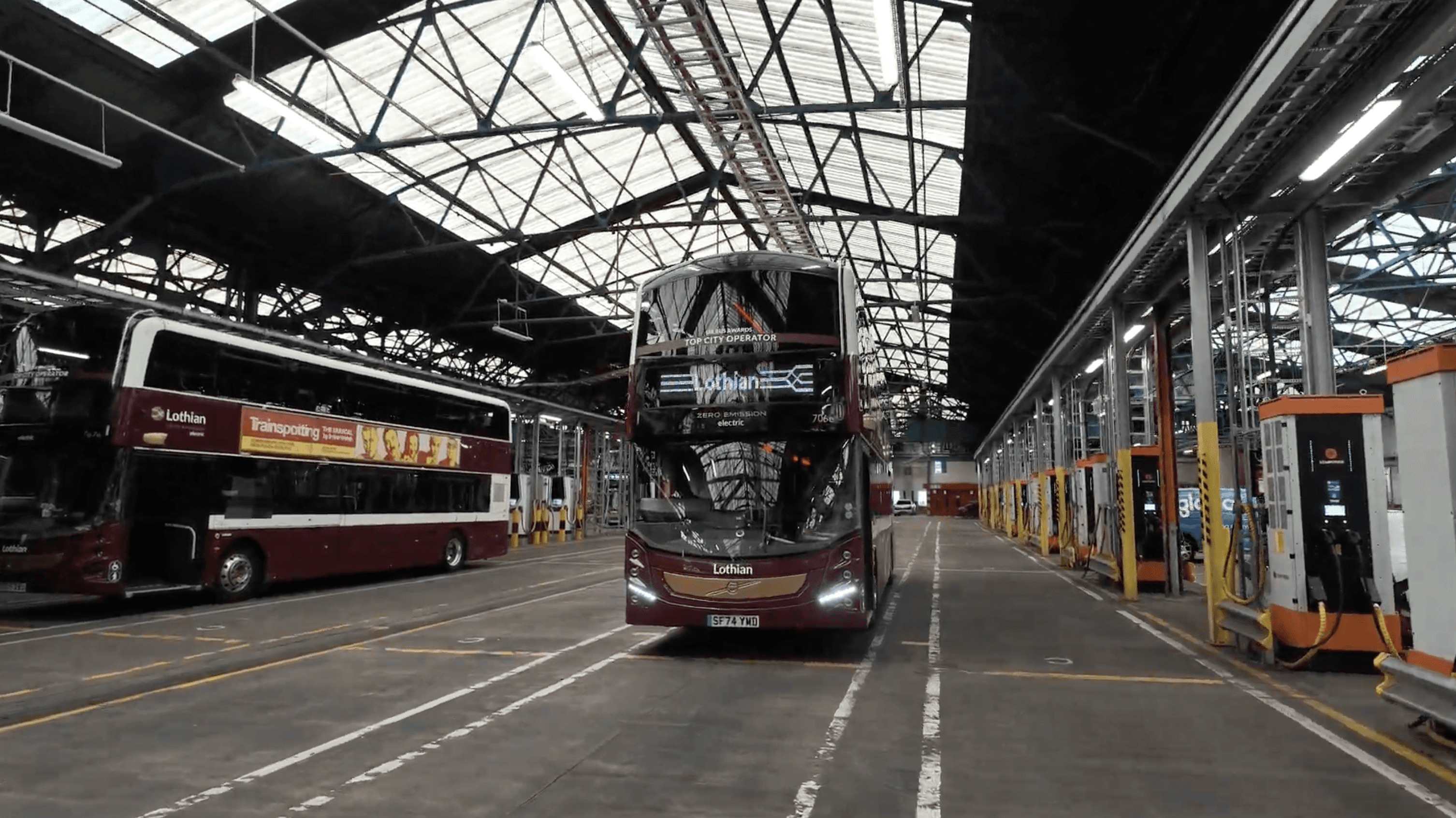
The transition was sequenced transformer by transformer across Central Depot's three substation circuits. Each charger was migrated onto Optimo via OCPP reconfiguration with no hardware changes and no new infrastructure required. The moment a charger was reconfigured it was live on Optimo.
This is the same deployment model already proven in live production at First Bus Caledonia Road and currently running at Warrington's Own Buses. The approach is consistent because the platform is built for exactly this environment.
100% Vehicle Pull-Out Maintained | 48 Hours Full Site Transition | 116 Connectors Under Management
What Changed
Optimo mapped the full depot layout in hours. Every charging row was configured with its own scheduling logic and departure-order priority structure. Power is now distributed dynamically across all three transformer circuits - no equal allocation, no manual overnight intervention.
Every charger migrated via OCPP reconfiguration. No hardware changes. No new infrastructure. No disruption. Hardware agnostic across Kempower and Nidec - the moment a charger was reconfigured, it was live on Optimo.
Lothian's team now has a single screen: real-time charger status, vehicle state of charge, and readiness alerts for every bus. ML-driven fault detection catches anomalies before they affect dispatch. Self-healing infrastructure resolves most issues remotely.
The manual overnight workaround Edinburgh's bus network had been depending on no longer exists.
What This Means
Most platforms take weeks to deploy. Optimo was live across a 116-connector depot in 48 hours - under emergency conditions, with Edinburgh's entire morning pull-out depending on the outcome.
First Bus was a planned proof of concept. Warrington's Own Buses was a structured transition. Lothian was an emergency. The platform performed identically in all three. For any operator whose CPMS dependency is a single point of failure, the Lothian deployment answers the question every operations director eventually asks: what happens if the platform fails?
48 hours. 116 connectors. 100% pull-out. Edinburgh didn't miss a bus.

Beyond Charging
Unlocking Energy Value
Operational continuity was the immediate priority. But Optimo's Fleet Energy Operating System offers more than charging management.
With approximately 3 MW of potential tradable flexibility at Central Depot, there is an opportunity to generate additional revenue from existing charging infrastructure.
Elsewhere, we have seen flexibility opportunities with indicative gross revenues of £40,000 to £50,000 per MW annually, demonstrating the potential value of intelligent energy management.
For Lothian, this could represents a potential future opportunity, with fleet readiness always taking priority over energy trading.
Delivered under emergency conditions at Lothian Buses Central Depot, Edinburgh.
✔ Emergency Transition in 48 Hours
✔ Hardware Agnostic
✔ Dynamic Load Management
✔ 100% Pull-Out Maintained
✔ Flexibility Revenue Ready
When Lothian identified a critical risk to its existing charging management platform, there was no room for operational disruption. Lothian acted quickly, and so did we. Once we received the green light, Optimo transitioned the entire depot to our platform within 48 hours, protecting charging operations and keeping the fleet moving. That's what it means to build for mission-critical fleet operators.
– Mo Ismail, Global Director of Sales, Optimo Energy
This isn't a pilot. It's a proven, repeatable model. Your depot is next.
this Company
About LothianBuses
Lothian play a vital role in helping you travel around the region. They connect the region with over 70 services and more than 700 buses which run day and night throughout the year. They are the UK’s largest municipal bus company and proudly owned by the City of Edinburgh, East Lothian, Mid Lothian and West Lothian councils. They have been based in the city for almost 100 years and are now one of the region’s largest employers with over 2,500 people, 1,700 of whom are drivers.

© Copyright Optimo Energy Limited. All Rights Reserved.