Does Your Electric Fleet Depot Actually Need a BESS?
When does battery storage make sense at an electric fleet depot? A practical guide to grid constraints, peak shaving, solar, charging, resilience and BESS economics.
Written by:

Battery storage is becoming one of the most discussed assets in fleet electrification. That does not mean every electric depot needs one. A BESS can be extremely useful. It can also become an expensive asset solving a problem the depot did not actually have. The right question is not “should we buy a battery?” It is “what problem are we trying to solve, and is storage the best way to solve it?”
Start with the fleet and the grid
Before sizing a battery, understand the vehicle energy requirement, return and departure windows, charger capability, grid connection, transformer constraints, building load and future fleet growth. Sometimes the apparent need for storage is actually a control problem. Better load management can unlock capacity already available within the site. Warrington’s Own Buses is a good example of why operators should first understand how effectively the existing connection is being used.
In other depots, the constraint is genuinely physical. A battery can then create additional options.
Where a BESS can add value
A BESS can charge when power is cheaper or more available and discharge when the depot is constrained. It can reduce peaks, support high-power charging, capture on-site solar that might otherwise be exported or curtailed, and potentially participate in flexibility markets where the technical and commercial conditions are right.
It can also create resilience in parts of the energy system, although the ability to support charging during an outage depends on the electrical design, inverter capability, controls and islanding arrangements. A battery on site should never automatically be described as backup power.
Great Yarmouth: the value is in the orchestration
At First Bus Great Yarmouth, the important story is not simply that the depot brings together electric-bus charging, solar and battery storage. It is that those assets can be orchestrated behind the meter around the vehicle operation.
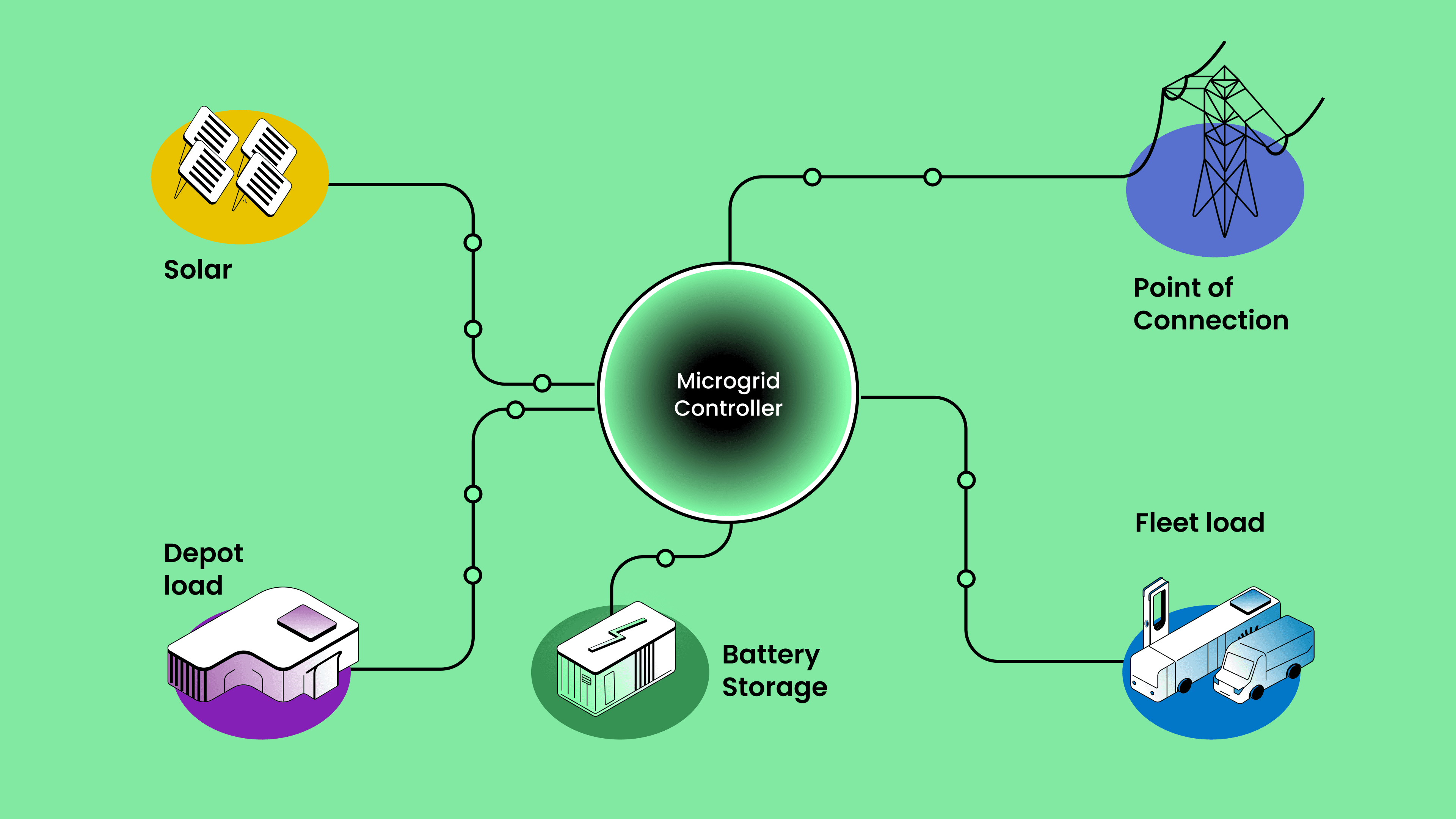
Optimo’s Microgrid Controller can monitor the grid position and local energy flows, coordinate charging and integrated storage, and keep the fleet requirement as the hard constraint. Solar generation can be used where it creates the most value. Battery behaviour can support the wider site rather than operating independently from the charging plan.
A battery is not the strategy. The operating system is the strategy. Do not optimise the battery against the fleet
A battery optimiser may want to discharge because prices are attractive. A charging optimiser may want maximum power because vehicles are connected. A solar controller may want to maximise self-consumption. If those systems do not share the same operational context, individually sensible decisions can conflict. The fleet requirement has to sit above them.
That is why Optimo treats the depot as a microgrid: vehicles, chargers, grid, building load, solar and BESS are parts of one energy system.
How should a fleet decide?
Model the depot first. Quantify the actual constraint. Establish the hours in which it occurs. Understand whether smart charging can solve it. Then model what a battery changes: avoided infrastructure cost, peak reduction, solar utilisation, tariff value, market value and operational resilience. Finally compare those benefits with the battery’s capital cost, degradation, efficiency losses and usable lifetime.
The answer may be yes. It may be not yet. It may be that a smaller battery combined with intelligent charging produces a better result than a large standalone system. The objective is not to install more energy assets. It is to make the depot work better.
Found this insightful?
Share on LinkedIn
More from Optimo

News
SEE Services appoints Optimo Energy to support London Ambulance Service’s electric fleet operations
Optimo’s Fleet Energy Operating System will connect charging infrastructure, vehicle intelligence and site energy management across a programme encompassing more than 700 charging connectors.
Read More >

Insight
How Optimo Actually Works: From Fleet Data to an Adaptive Operating Loop
A technical look at how Optimo combines CPMS control, fleet forecasting, microgrid orchestration and energy trading to continuously optimise an electric depot.
Read More >

News
From charging buses to managing energy: What First Bus's Caledonia depot tells us about the future of electric fleets
Discover how Optimo Energy connects fleet charging, energy management and flexibility at First Bus's Caledonia depot in Glasgow.
Read More >