Why Fleet Readiness Must Come First in EV Charging
Why 100% fleet readiness must be the first priority in EV charging, before energy optimisation or flexibility revenue.
Written by:


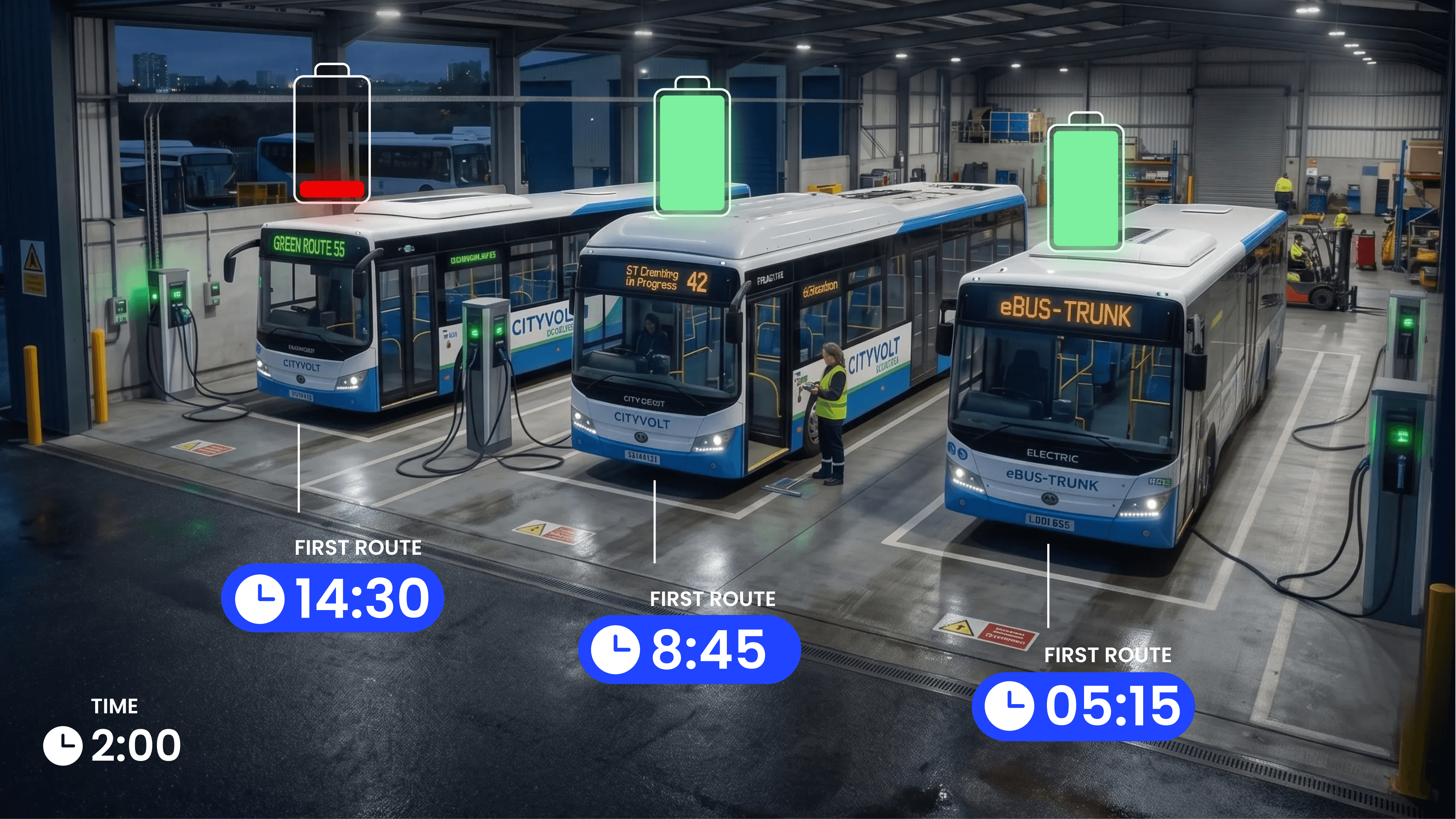
The worst time to discover a charging problem is five minutes before a vehicle is due to leave. At that point, the dashboard can tell you exactly what went wrong. It does not give you the hours back. Fleet charging therefore has to begin with a different question. Not: “Are my chargers online?” But: “Will every required vehicle be ready when it needs to leave?” That is fleet readiness.
It sounds obvious, yet much of the charging industry still measures infrastructure rather than the operation the infrastructure exists to support. A charger can be online while a vehicle is undercharging. A session can remain active while power has fallen below the level required. A late-returning vehicle can be connected perfectly and still not have enough time to reach the energy needed for its next duty. None of those situations is captured by a simple green charger icon.
Readiness requires context. The system needs to understand the vehicle, its state of charge, the energy requirement for the next duty, the departure time and the time remaining to recover if something changes. That context also determines how site power should be allocated. Imagine two buses connected behind a constrained grid connection. One leaves in 45 minutes and needs 80kWh. The other leaves in six hours and needs 120kWh. Giving them equal power may be electrically neat, but operationally wrong.
The first vehicle has the tighter deadline. Fleet Energy Orchestration should understand that. This becomes even more important overnight because the plan rarely survives untouched. Vehicles return late. Consumption differs from forecast. A driver connects to another bay. A charger faults. A vehicle comes back with less energy than expected. A static charging schedule can only tell the depot what should have happened. A fleet operating system has to respond to what is happening now.
That is why Optimo puts readiness at the top of the decision hierarchy. If a vehicle requires energy to protect service, it gets priority. Cost optimisation comes after that. Flexibility trading comes after that. Everything comes after that. This is not a philosophical preference. It is a commercial requirement.
The value of saving a few pounds on energy disappears very quickly if a bus misses service or an HGV misses a delivery window. The same is true for flexibility revenue. A fleet should never create a new energy-market revenue stream by introducing operational risk into the transport business that paid for the infrastructure in the first place. Readiness is what makes optimisation safe.
Once Optimo knows which vehicles are protected and where genuine spare dwell time exists, the remaining load can become flexible. But the operating rule never changes: 100% fleet readiness is the target. Because the purpose of fleet charging infrastructure is not to charge vehicles. It is to operate a fleet.
For Optimo, the fleet comes first. Always. Energy optimisation is valuable only when every required vehicle is ready for its next duty. Readiness and uptime measure different things
A charger can report that it is online while a vehicle is receiving too little power to meet its departure requirement. Equally, a charger fault does not necessarily mean a missed duty if it is detected early enough for the vehicle to be moved or charging to be recovered. Monitor charger availability, but judge the charging operation against the vehicles actually required for service.
Found this insightful?
Share on LinkedIn
More from Optimo

Insight
How Optimo Actually Works: From Fleet Data to an Adaptive Operating Loop
A technical look at how Optimo combines CPMS control, fleet forecasting, microgrid orchestration and energy trading to continuously optimise an electric depot.
Read More >
Insight
What Happens When Something Goes Wrong at 2am?
What happens when charging goes wrong overnight, and why early detection, remote intervention and 24/7 support protect morning dispatch.
Read More >

Insight
The 10 Questions Every Fleet Operator Should Ask Before Choosing a Charging Platform
Ten questions every fleet operator should ask when choosing EV charging software, from vehicle readiness and load management to market access.
Read More >
© Copyright Optimo Energy Limited. All Rights Reserved.